Heart of Baekdu: Call of the Cold Stars
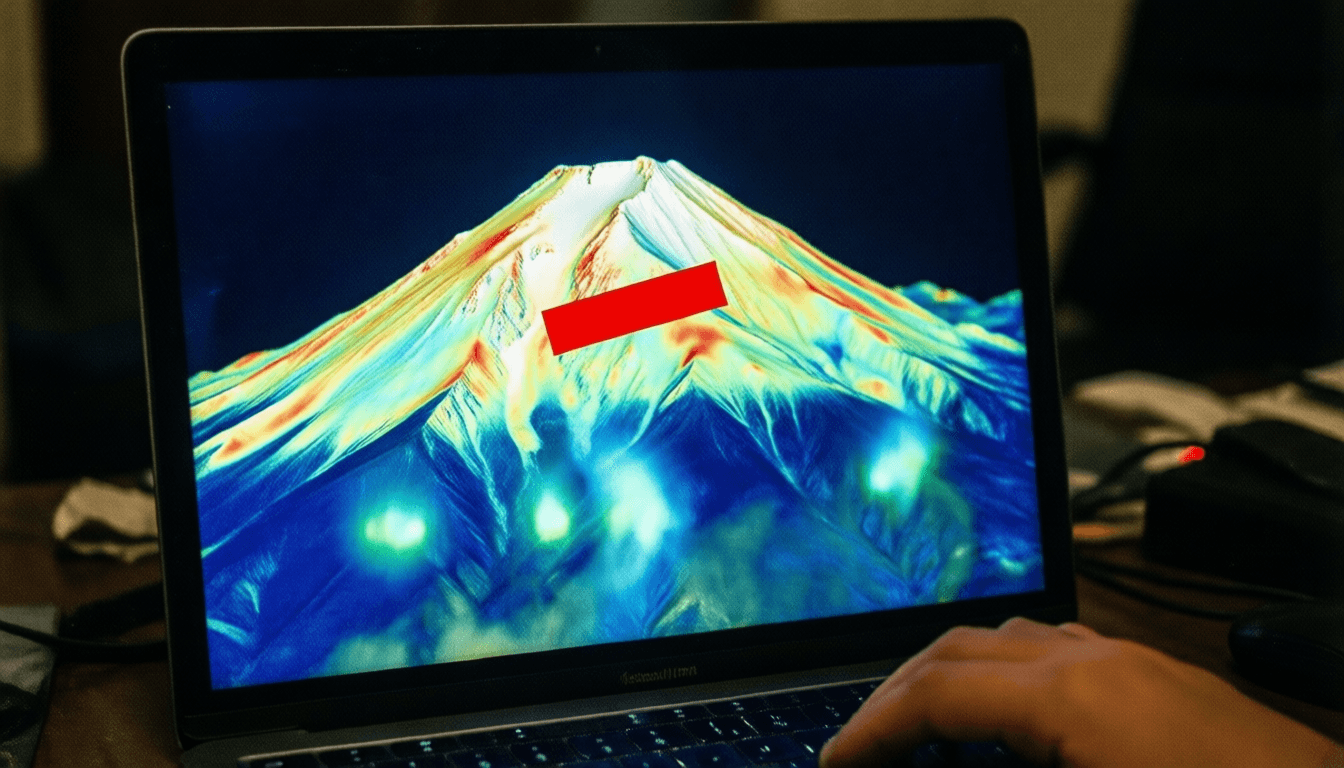
The first whispers of periodic low-frequency vibrations detected beneath the Baekdu Mountain caldera began in obscure online geological forums. Initially dismissed as ramblings from disgruntled former employees, the posts detailed rhythmic pulsations unlike typical tectonic shifts or predictable magma pulses, as if a colossal living entity were breathing. One research assistant, involved in a joint North Korea-China seismic monitoring project near Heaven Lake, even mentioned inexplicable localized subsurface temperature drops inconsistent with geothermal models. The posts soon vanished, but some satellite thermal images, allegedly taken by a private firm, briefly circulated on dark web forums, partially redacted. These images revealed a distinct 'cold plume' emanating from deep within the volcano's ice-capped summit, entirely distinct from ordinary glacial melt. Crucially, faint, erratic lights were captured beneath the ice in these images, though officially dismissed as sensor errors or mineral luminescence. Yet, among indigenous communities bordering Baekdu Mountain, ancient legends tell of 'Light Eaters' or 'Cold Stars' living beneath the highest ice, drawing warmth from the unwary and leaving only silence. These stories gained chilling new weight in recent years with a surge in inexplicable disappearances of solo climbers and illicit mineral prospectors in Baekdu's remote high altitudes. Causes of death were always attributed to harsh weather and treacherous terrain, but never entirely explained.
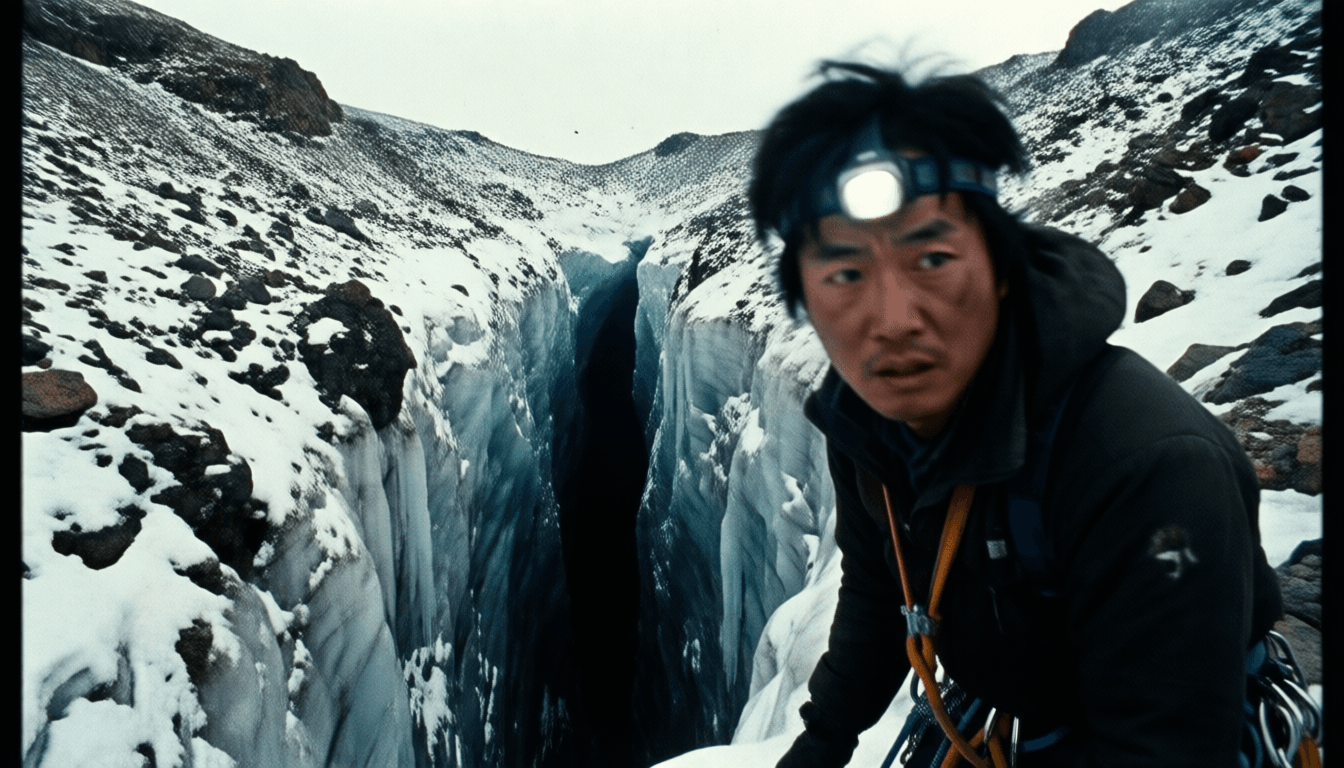
Lured by the data inconsistencies and their ominous alignment with regional lore, my research, focusing on extremophile microbiology and subglacial geophysics, provided an academic pretext. I secured access to a highly restricted area on Baekdu's northern slopes under the guise of 'glacial stability studies'. Triangulating the anomalous seismic patterns and leaked thermal images, I located a previously unrecorded, narrow ice crevice. Disguised by recent snowfall and natural rockfall near the crater rim, it plunged steeply into the mountain's depths. Not a volcanic vent, but a true ice cavern. Equipped with specialized climbing gear, various geological sensors, a thermal camera, and a portable ground-penetrating radar (GPR), I began my descent. The air immediately grew heavy, pressed in by a damp, mineral-rich frigidity. The crevice walls were smooth with ancient ice, yet beneath my headlamp, strange, almost crystalline formations glowed faintly. Initially, I dismissed them as optical illusions from trapped mineral deposits. However, the GPR painted a shocking picture: a vast, empty space existed below, far larger than any known glacial fissure. The silence was profound, almost oppressive. It seemed to swallow even the scrape of my boots and the clink of my carabiners.
Deeper I went, and the silence became not merely an absence of sound, but a palpable presence. Even my own breathing, unnaturally loud at first, seemed to be drawn into the void. The echoes I expected when I called into the abyss were either delayed, distorted, or simply never returned. The faint luminescence from the ice walls grew more intense, no longer a reflection, but emanating from the ice itself. It was not constant; subtly, asynchronously, it pulsed with an iridescent blue-green, reminiscent of deep-sea bioluminescence. My headlamp, despite fresh batteries, seemed dim and hazy, as if losing its light. Thermal sensors recorded extreme localized cold. Certain points on the ice floor registered temperatures far below zero, while immediately adjacent ice patches felt abnormally warm to the touch. Not hot, but like perfectly chilled flesh. Water droplets from my body heat, forming on the ice floor, seemed to freeze in reverse, forming intricate, fractal patterns spreading outwards from their centers, defying normal crystallization. The ice itself appeared subtly animated. Crystalline structures on the walls seemed to shift in shape or grow when I looked away and back again. I repeatedly told myself it was an illusion caused by the light and cold. My compass spun erratically, and my robust communication system buzzed with static before failing completely. GPS signal vanished. The incessant soft pulsing of the 'Light Eaters', the unsettling silence, and the impossible physics slowly eroded my scientific objectivity. A primal unease took hold. This was not merely an unknown geological formation, but something active, something that was, in its alien way, aware. I found myself whispering to myself, to ensure I could still make a sound.
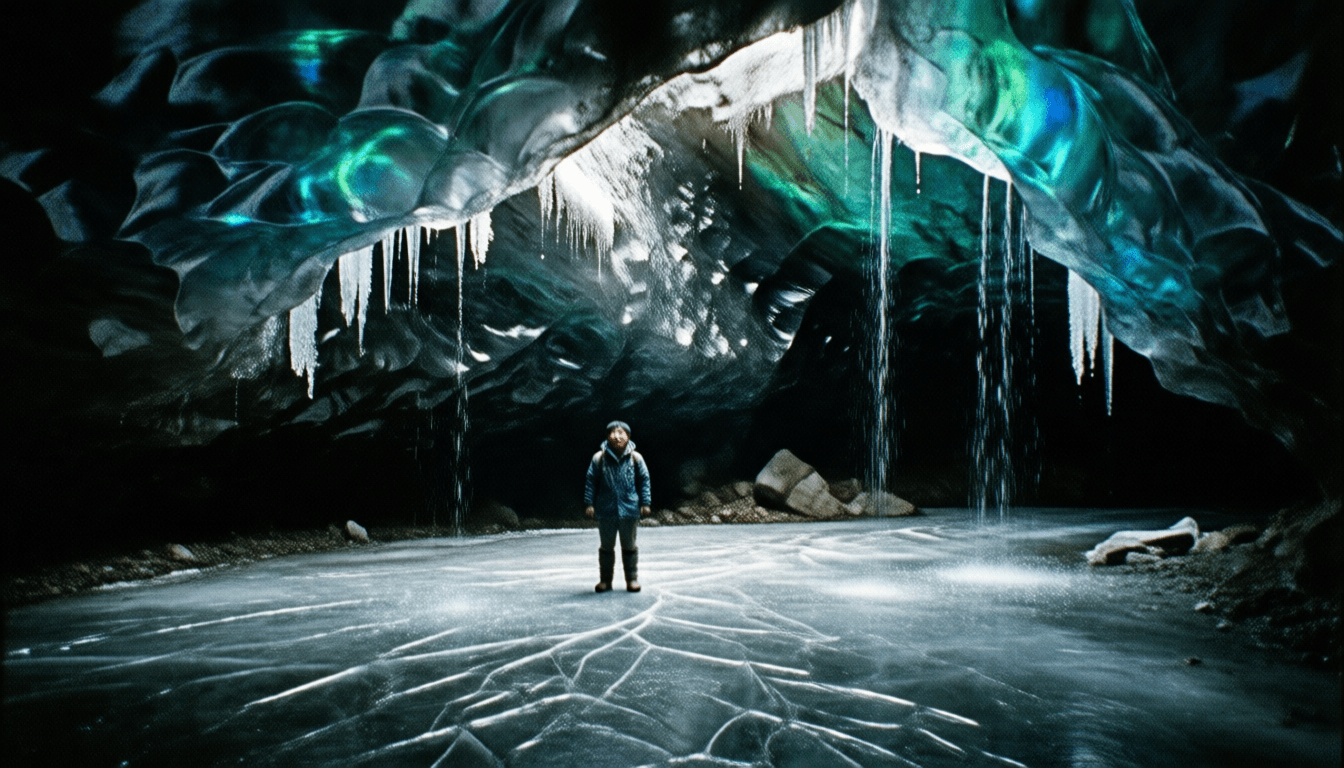
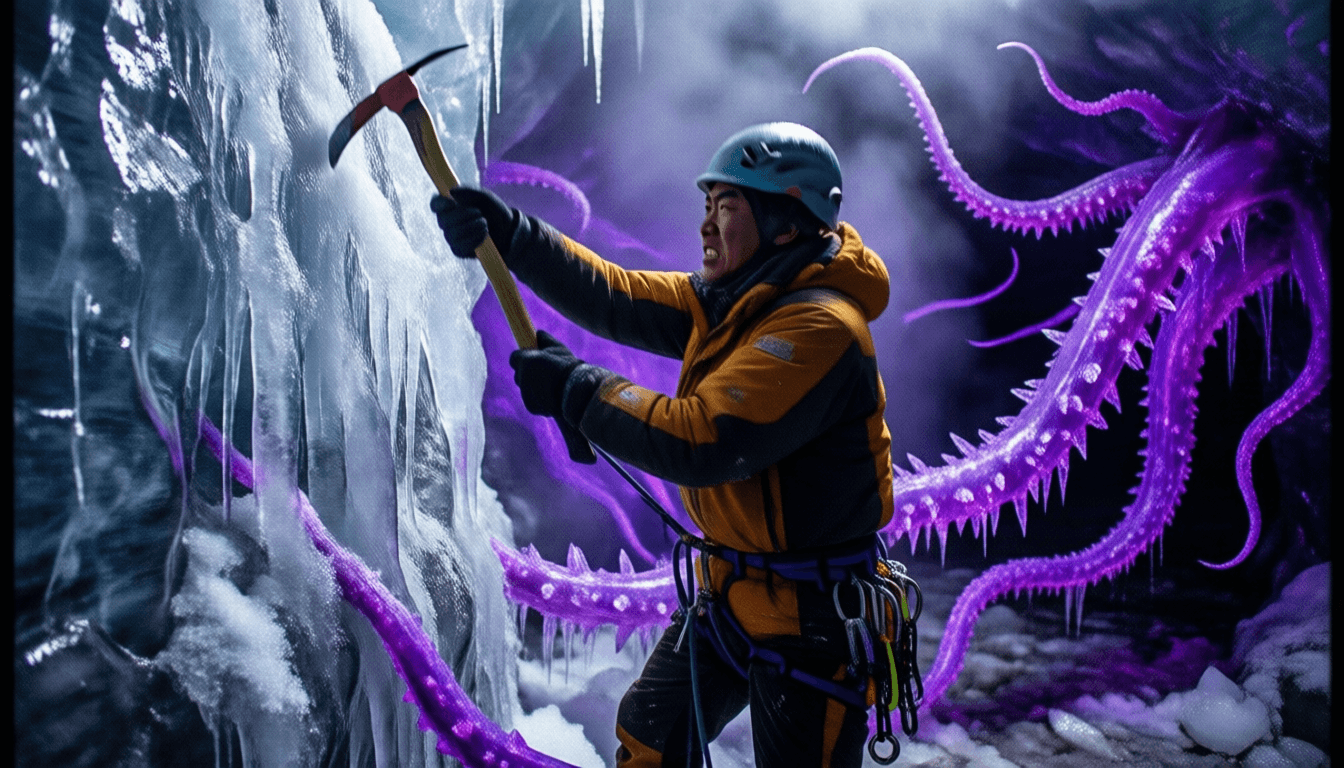
I breached into a vast subglacial space, one that even the GPR had only hinted at its true scale. The entire expanse pulsed with bioluminescence, revealing a breathtakingly beautiful yet simultaneously terrifying landscape. Massive ice structures, crystalline formations, and what appeared to be frozen, translucent flora extended into the cavernous gloom. This was the 'Glacier Garden'. The moment I activated my GPR to map its full extent, a resonating 'hum' emanated from the ice itself. A vibration beyond sound, shaking my very bones. The pulsing lights intensified dramatically, shifting from soft blue-green to a furious, aggressive violet. The 'plants' of the Glacier Garden began to move. What I had believed to be inert ice formations were in fact complex, semi-fluid structures. Tentacles of bioluminescent ice and living crystalline mass detached from the walls and floor, reaching for me. The air temperature plummeted instantly, causing immediate, excruciating pain to exposed skin. My breath felt like it was freezing in my lungs. Parts of the previously stable, massive ice ceiling began to flow downwards like thick liquid. Not shattering, but reforming into solid walls, trapping me in a rapidly shrinking space. My escape route was sealed. The tentacles, now thick as cables and glowing from within, advanced with horrifying speed. They were not sharp, but moved with a terrible, slow inevitability. I felt a profound, chilling sense of absorption. This organism was not predatorily attacking; it was merely perceiving me as an anomalous component to be assimilated, to be integrated into its environment.
As oxygen grew thin and the encroaching tendrils brushed against my protective suit, I frantically activated a high-frequency sonic disruptor I had brought for ice fracturing. The sound, amplified by the confined space, created a painful resonance, causing the crystalline tendrils to momentarily recoil, their luminescence flickering erratically. With the last of my desperate strength, I swung my climbing axe, shattering a weak point in the newly formed ice wall, scrambling up through the collapsing passage as the organism's glowing mass pulsed violently behind me, and the silence was broken by the sickening creak of ice reforming. In my desperate, blind ascent, I suffered severe frostbite and lacerations, barely escaping to the surface as the crevice entrance sealed itself shut behind me with unnatural finality.
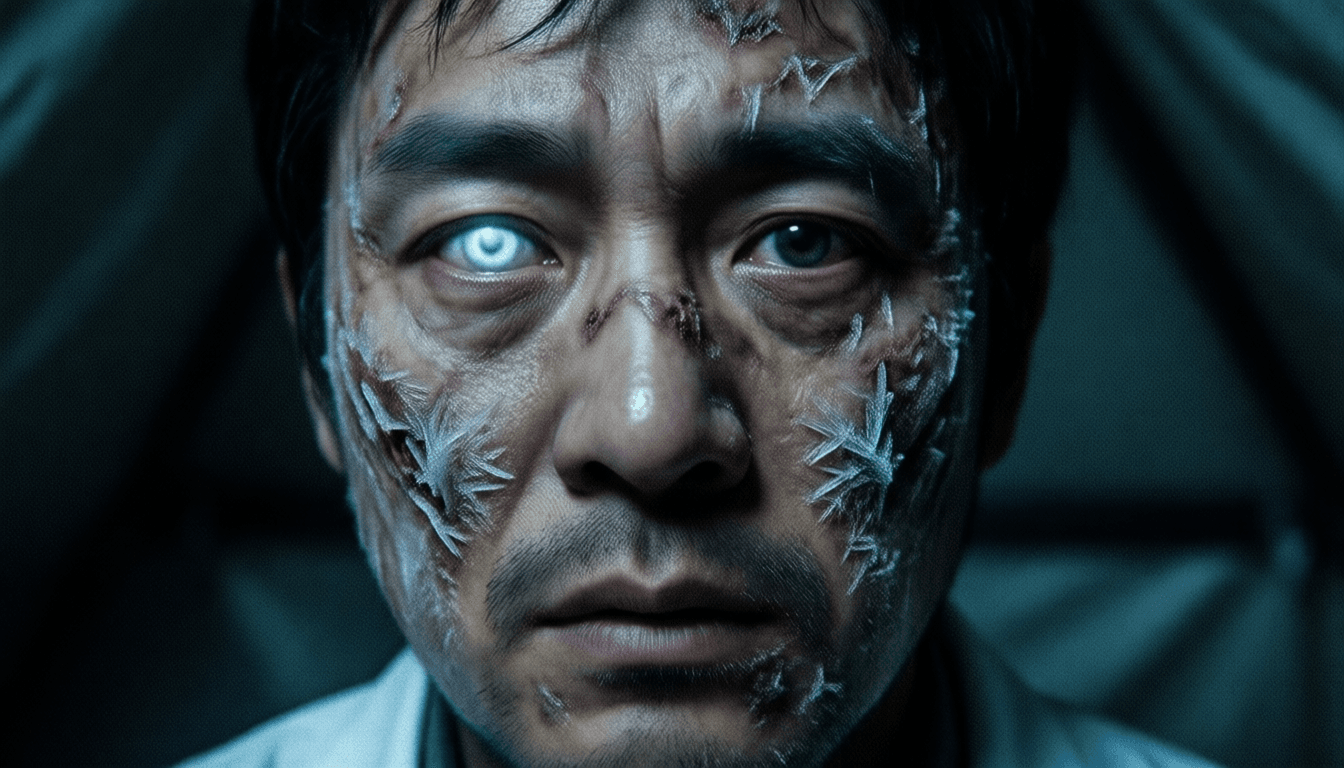
I emerged, severely hypothermic and delirious, but alive. My hands and face bear deep, unhealing frostbite scars that resist conventional medical treatment, exhibiting a strange, almost crystalline texture and a faint internal luminescence under specific frequencies of light. My left eye, exposed during the descent, is now permanently dilated, emitting an almost imperceptible cold blue glow in complete darkness. My geological sensors and GPR data were irrevocably corrupted, displaying impossible readings: seismic vibrations as complex biological rhythms, thermal maps showing negative Kelvin temperatures, and GPR images depicting impossible, non-Euclidean geometries within the mountain. The critical sonic disruptor I used had transformed into an unrecognizable crystalline mass. A minuscule fragment of the 'organism' itself, a translucent, pulsating micro-crystalline structure, was found embedded in my damaged suit. Under microscopic analysis, it defies classification, exhibiting properties of both mineral and biological matter. It displays slow, periodic 'breathing' and an astonishing ability to draw energy from ambient cold. It subtly grows when exposed to low temperatures and specific spectra of light. My attempts to report my findings were immediately dismissed, my story attributed to psychosis and trauma from severe hypothermia. The official narrative solidified: 'geological instability' caused the crevice to collapse, effectively sealing it. But seismic anomalies, however subtle, continue, and whispers of the 'Cold Stars' are beginning to circulate again at the fringes of the research community, sometimes now accompanied by mentions of a strange, new light seen in the eyes of those who claim to have ventured too close to the sealed summit. I myself no longer feel the cold, my body maintaining an abnormally stable temperature. I often stare into the darkness, the faint blue light reflecting from my left eye, haunted by the knowledge of the vast, alien life sleeping deep within Baekdu Mountain. The 'Glacier Garden' is not merely an ecosystem. It is an entity, and I am now, irrevocably, a part of its silent, cold world.
[ CLASSIFIED VERDICT ]
[ACCESS LOG - SOURCE FILE]
Among the indigenous communities bordering Baekdu Mountain, ancient legends tell of 'Light Eaters' or 'Cold Stars' living beneath the highest ice, drawing warmth from the unwary and leaving only silence. These stories gained new relevance in recent years with a surge in inexplicable disappearances of solo climbers and illicit mineral prospectors in Baekdu's remote high altitudes.