
The Failsafe of Silence
For a long time, it was nothing more than a rumor. A whisper that circulated only in the forgotten corners of early internet forums, or in the cryptic footnotes of self-published 'alternative history' books. It was a story about a specific piece of evidence from the Pan Am Flight 103 bombing. Not a bomb fragment or aircraft wreckage, but a part of an LD3 unit, a luggage container commonly cited as the blast origin.
Official reports stated that the LD3 was completely destroyed. But the rumor claimed that an unusually intact panel, no larger than a briefcase lid, was found miles from the main debris field in a secluded forest near Tundergarth. The significance of this fragment wasn't its mere survival. Within its material structure, there was a subtle, almost imperceptible discoloration, which official forensic teams allegedly dismissed as incidental heat damage. But an anonymous post in a now-defunct conspiracy theory forum in 1999 told a different story. The poster, claiming to be a former junior technician involved in the early Lockerbie recovery, asserted that this fragment was 'quarantined.' Not for forensic analysis, but for 'special processing,' moved to an unofficial, temporary holding facility on the outskirts of Dumfries. The post mentioned a 'faint hum' emanating from the panel and ended abruptly with a warning: "Don't look for the failsafe. It keeps its own silence." The user account vanished days later.
It was this lead that captivated Dr. Aris Thorne, a retired archivist with a reputation for delving into the boundaries between official history and pervasive local legends. He stumbled upon the post years later, buried in archived material from a defunct Usenet group. The author was untraceable, the claims officially dismissed as unfounded speculation. But the specificity, the 'faint hum,' and the very concept of a 'failsafe' resonated with patterns Dr. Thorne had observed in other, unrelated narratives of cover-ups.

Dr. Thorne’s tenacious cross-referencing of land records, defunct government contracts, and old maps eventually led him to a disused industrial facility on the outskirts of Dumfries. Hidden behind a dense hawthorn hedge, it was unremarkable, its corrugated iron cladding rusted and peeling. A faded, almost illegible sign still bore the name of a short-lived government procurement subsidiary that existed only in the early 90s.
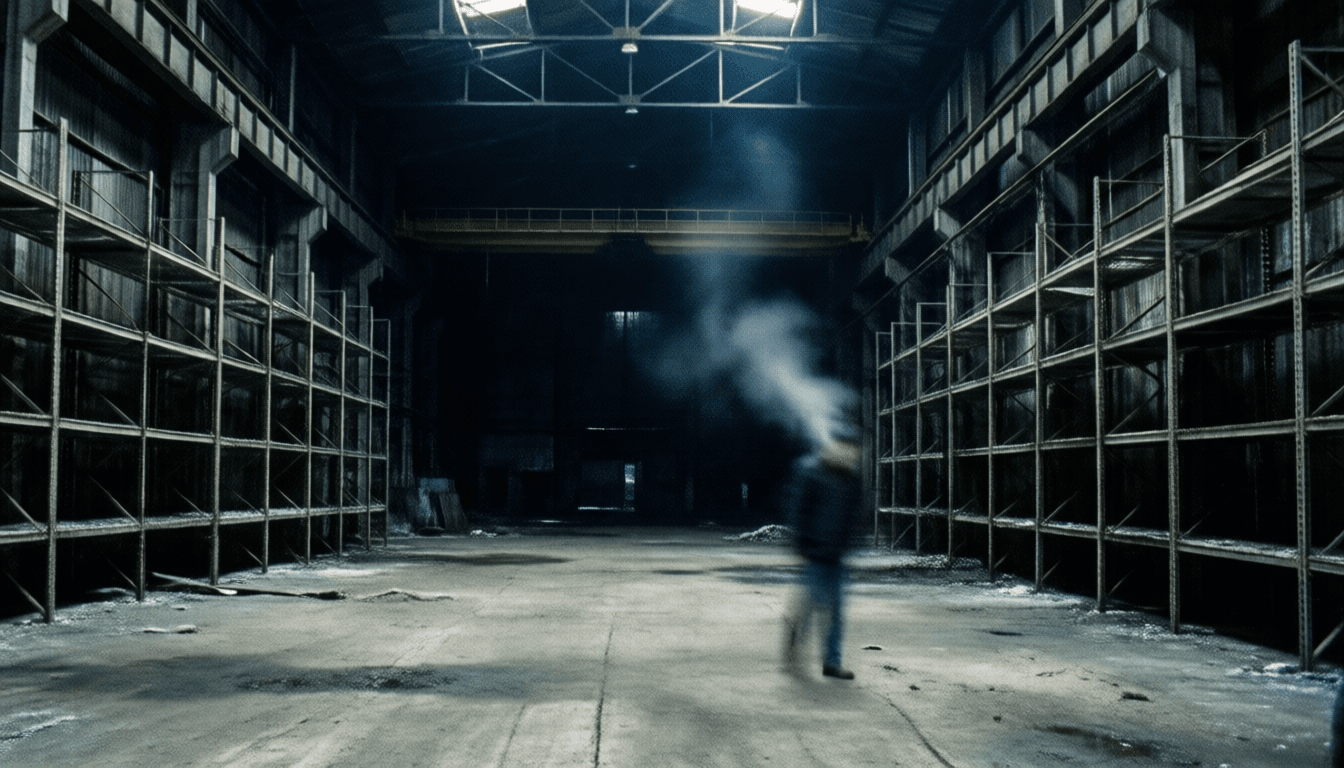
Entry was surprisingly easy. A side door, concealed behind thick bramble bushes, was unlocked and warped by decades of neglect. As Dr. Thorne stepped inside, armed with a powerful LED lantern, the air within was thick with the smell of damp concrete and old dust. The building was a vast single-story structure, clearly repurposed multiple times, divided by ad-hoc drywall partitions. Bare, skeletal shelves stretched into the darkness. A chill was immediately palpable, a physical presence in the air. His breath plumed into the stale air, and the scuff of his boots on the rough floor sounded unnaturally muted, as if absorbed by the vast, quiet space.
Deeper within, the silence became more pronounced, almost overwhelming. It wasn't merely an absence of sound; it was an active vacuum, a pressure that bore down on his eardrums. The echo of his footsteps, which he'd anticipated, never materialized. A tentative whisper from his lips dissipated unnaturally inches from his mouth, as if the very air devoured sound.
Other anomalies were present. A faint, high-frequency hum, just at the edge of human audibility, seemed to pulse rhythmically from the concrete floor beneath his feet. Unnaturally cold drafts of air brushed his face. Not logical crosscurrents, but slow, deliberate eddies that seemed to originate from the center of the vast space and vanish into nothingness. He discovered an unmarked section walled off by thicker, insulated panels. Faint, almost invisible chalk marks on the floor indicated a past “quarantine zone.” In a high corner, a small red LED on what looked like an old, disconnected CCTV camera showed a dim, almost imperceptible flicker—a phantom brush of activity in the profound darkness. The hairs on his arms stood on end. This was not merely an abandoned building. It was an environment carefully, precisely engineered for a specific purpose.
Dr. Thorne located a narrow, heavy steel door, cleverly integrated into the insulated wall. It was secured by a nearly industrial-grade combination lock. An hour of methodical manipulation, drawing upon his arcane knowledge of security mechanisms, yielded a click of tumblers. The door swung inward on well-oiled hinges, revealing a small, starkly sterile room, far colder than the main warehouse.
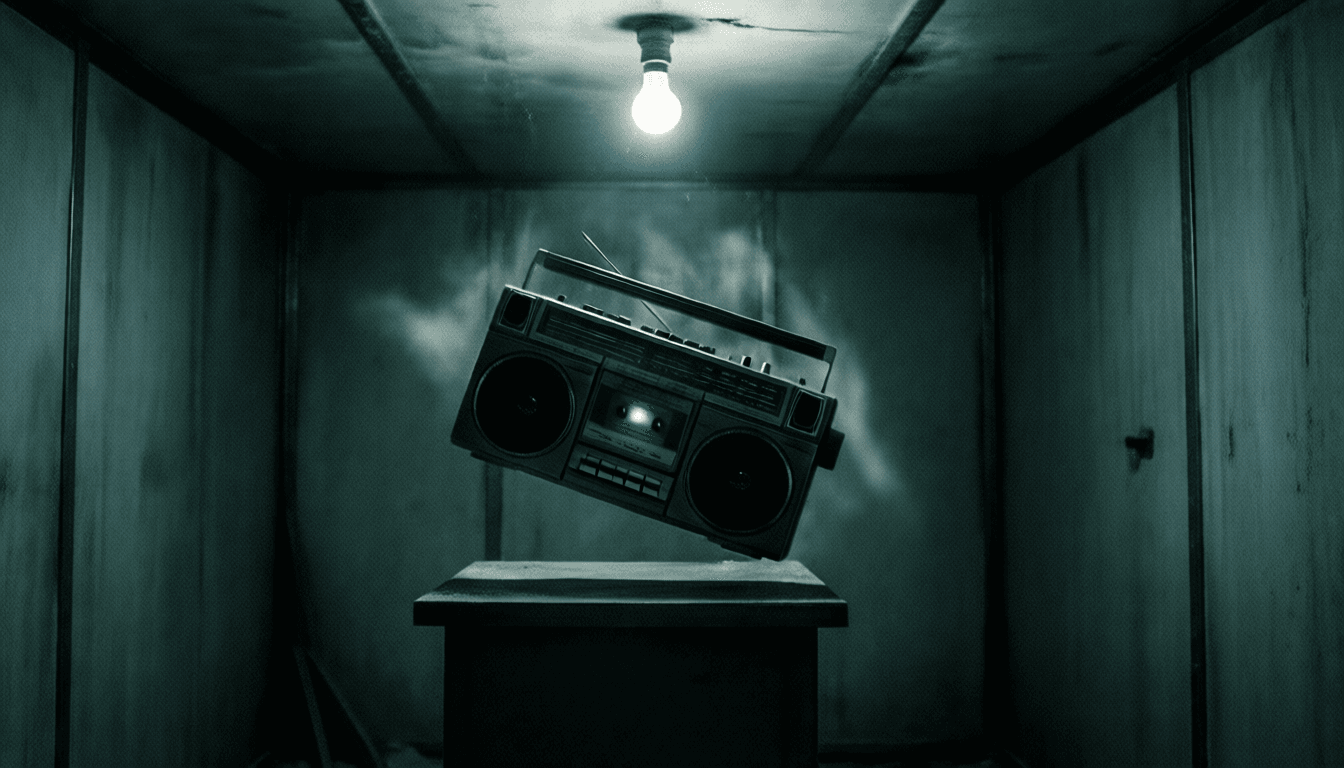
The room was empty save for a single, waist-high pedestal in its center. Upon it, perfectly preserved under a thin film of dust, sat a high-end, portable high-fidelity recording device from the early 90s, powered on. A single, small green light glowed. As Dr. Thorne fully entered the room, the device activated. A low, disorienting hum filled the small space, vibrating through the floor, rising in pitch, quickly becoming physically uncomfortable. It was the 'faint hum' mentioned in the forum post, now amplified, causing a dull ache behind his eyes and pressure in his chest.
Suddenly, with an absolutely chilling thud, the heavy steel door slammed shut behind him, trapping him within. The sound resonated for a fleeting moment, only to be swallowed by the room's artificial silence without a trace, leaving only the intensified hum. A single bare bulb in the small room's ceiling flickered, then died, plunging Dr. Thorne into near-perfect darkness, with only the faint green glow of the recording device for illumination. Then came the most unsettling event. The recording device on the pedestal, still emitting its disorienting hum, vibrated violently, then incredibly, lifted itself several inches into the air above the pedestal surface, hung for a breath, and then dropped with a shattering crack, its casing disintegrating.
Dr. Thorne felt a deep, chilling realization. This was no ghost. No simple trap. It was a system. The hum, the overwhelming silence, the inexplicable movement of the recorder—these were all elements of an artificial containment, a 'failsafe,' designed not to protect the fragment, but to protect the secret it represented. The air in the room grew strangely heavy and thin. He felt a powerful suction, as if oxygen was being drawn from the chamber. It was designed to disorient and incapacitate. He wasn't being chased by an entity, but suffocated by a cold, indifferent mechanism. It was designed to enforce silence at any cost. A cold, vivid terror scraped at his throat amidst the thinning air, the unrelenting hum, and the immovable steel door.
There is no record of how Dr. Thorne escaped. The details, blurred and fragmented by near-anoxia and overwhelming sensory assault, consisted only of desperate flailing, a desperate search for an emergency bypass, a service tunnel, anything. He stumbled out of the Dumfries facility into the cold air of dawn, gasping and shivering, the phantom hum ringing in his ears, his lungs burning.
He brought no physical evidence from the facility. If the fragment had ever truly been there, it was long gone, replaced by the chilling mechanism designed to suppress it. What he brought instead was a profound, visceral understanding of what 'silence,' wielded by such a force, truly meant. The unnaturally quiet air, the meticulously controlled drafts, the disorienting hum, the precise, chilling movements of the recorder—these were not supernatural phenomena, but the almost preternatural efficiency of a hidden organization. It was so advanced, so ruthless, that its manipulations appeared to the layman to transcend conventional physics.
Dr. Thorne filed an anonymous report, focusing on the environmental anomalies, with few personal details. He now reports a persistent fear, a subtle shift in his perception of the world. He unconsciously checks the airflow in his home, listens for unnecessary hums, and suffers from a low-level, constant anxiety that he is now a known variable. He understands that the true horror of the Lockerbie bombing was not simply the act itself, but the meticulous, almost surgical measures taken afterward to bury a specific truth. The 'faint hum' was not a sound, but a warning. And he heard it. A week after his return, his landline rang at precisely 3 AM. One short ring. Then silence. He didn't answer. He does not sleep comfortably.

[ CLASSIFIED VERDICT ]
[ACCESS LOG - SOURCE FILE]
After the 1988 Pan Am Flight 103 bombing, contrary to official reports that everything was destroyed, a rumor circulated about a strangely intact fragment of a luggage container found in a remote forest, emitting an unusual hum. This story is based on an urban legend claiming that this fragment was not sent for forensic analysis but moved to an unofficial facility for 'special processing,' where its truth is eternally silenced by a secret mechanism known as a 'failsafe.'