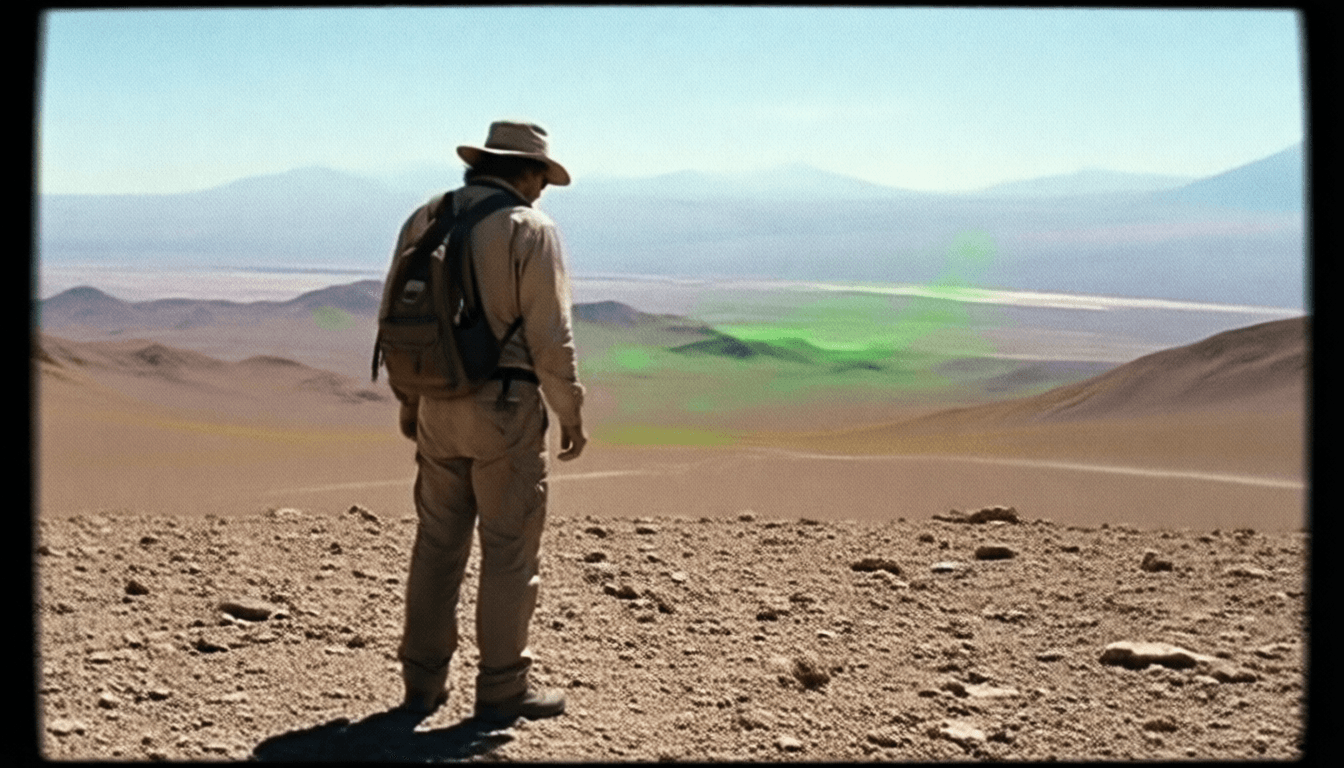
The Desert with a Beating Heart
For decades, whispers circulated among a handful of independent atmospheric researchers and fringe geologists about a phenomenal occurrence deep within the Atacama Desert. It wasn’t the familiar dryness or the high-altitude observatories. It was something far more impossible. These anecdotes spoke of a 'Green City', a metropolis that, against all odds in the world's driest hyper-arid desert, sustained itself through advanced cloud-harvesting technology. Mainstream science consistently dismissed these claims as mirages, elaborate hoaxes, or hallucinations induced by prolonged isolation.
However, in 2018, 'Sky-Watch Alpha', an amateur satellite imagery collective, released filtered multispectral images of the Atacama's hyper-arid core. Though faint, they showed anomalous points of unusually high chlorophyll density. These were too vast and geometrically consistent for natural oases, too persistent for transient algal blooms. More compellingly, scattered throughout these green zones were colossal, fractal-shaped structures that pierced the perpetual coastal fog layer. There was no metallic sheen, no regular mechanical joints to be found on these structures. Instead, they were organic. They resembled enormous, fossilized fungal growths or mineralized coral forms. Comment threads quickly filled with speculation about the 'Atacama Weave', rumored to be biomechanical cloud harvesters that made the impossible green possible. Even though Sky-Watch Alpha later retracted these images, citing "sensor noise" and "atmospheric interference"—a retraction widely considered suspicious—the coordinates remained. And with them, the unsettling question: perhaps the desert wasn't truly dead after all.
Following Sky-Watch Alpha's coordinates and an old geological survey map hinting at unpaved access roads leading into a restricted area, I headed into the Atacama. The journey was brutal. Days bled into an endless horizon of salt flats and sun-scorched rock. The air was thin and still, tasting of mineral dust. My equipment consisted primarily of atmospheric sensors, a high-resolution drone, and specialized spectrographic imaging devices. The almost imperceptible dirt track eventually ended at a corroded, unmarked fence post, beyond which my drone detected anomalous humidity readings.
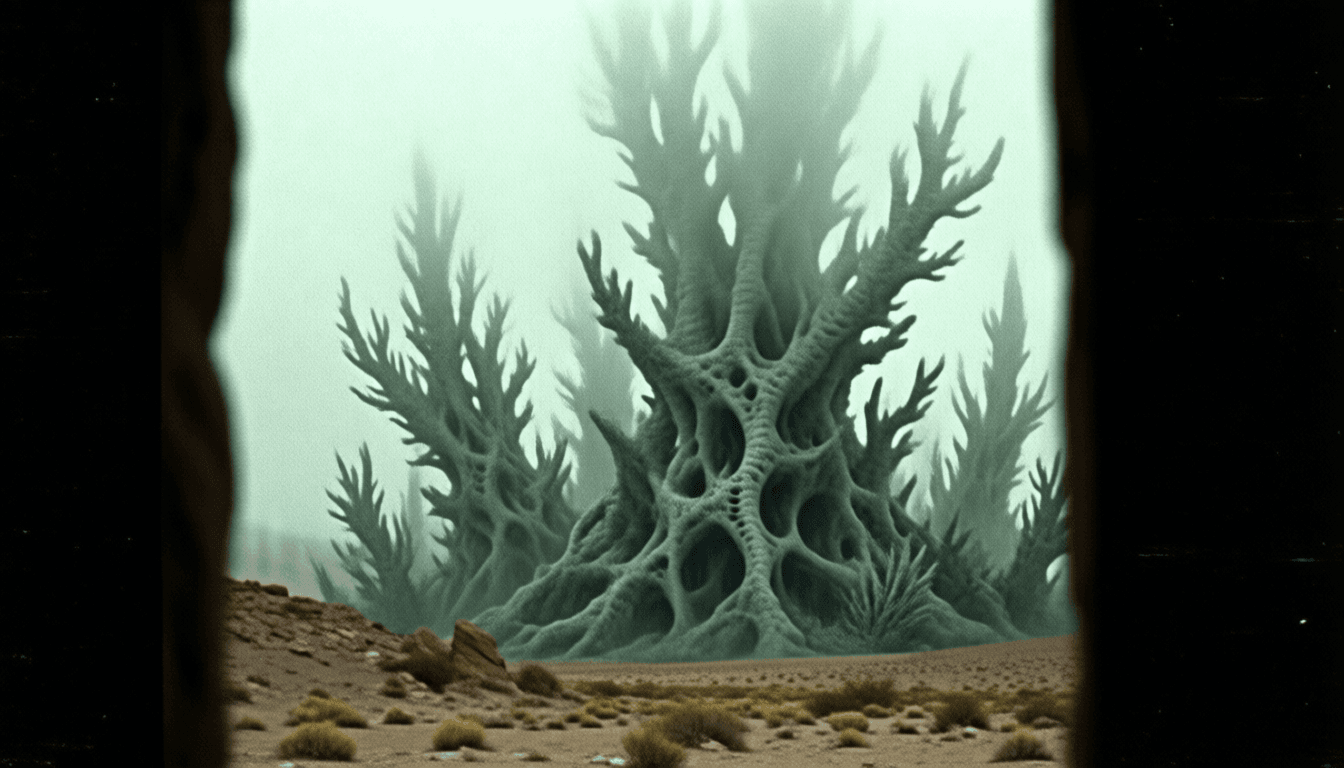
As I proceeded on foot, the landscape subtly shifted. The familiar desert haze gave way to a denser, cooler air mass. And then, through a sudden break in the low-lying fog, I saw them. Not machines, not architecture. They were colossal, intricate structures that defied categorization. Monumental, they stretched hundreds of meters skyward. Their surfaces were a mottled grey-green, blending perfectly with sparse lichens and dusty rock. They resembled calcified remnants of giant skeletal trees or alien coral reefs, their branches spreading into vast, delicate-looking lattice formations that seemed to inhale the low mist. There was no movement, no mechanical hum. Only an immense, almost overwhelming silence, broken only by the crunch of my boots on broken rock.
The deeper I ventured into the zone, the more the anomalies accelerated. The fog, instead of dissipating randomly, seemed to be drawn into the structures in an unsettlingly deliberate flow, as if being drawn by a vast, unseen breath. My environmental sensors registered localized extreme humidity and temperature drops that defied the physics of the surrounding arid environment, often occurring within mere meters of burning-dry ground.
A low, resonant thrum began to permeate the air. It was too deep to be heard with the ears, felt instead as a vibration through the chest. Not mechanical, but distinctly organic, like the sustained pulse of an immense, slow-beating heart. Climbing closer to one of the smaller tendrils near the ground, I observed its surface lined with microscopic, almost sub-visual channels. Each channel shimmered with a film of collected moisture, faintly blinking with an unsettling, almost bioluminescent iridescence. The collected water itself possessed an abnormal viscosity, slightly denser than usual, and a faint, metallic-sweet odor. A headache began to throb behind my eyes, a constant dull pressure, and a tingling sensation spread across my skin. The silence was no longer peaceful. It felt as though the entire colossal structure was silently observing my intrusion, a single, vast organism. Despite the coolness, the air felt thick, heavy with an unidentifiable energy.
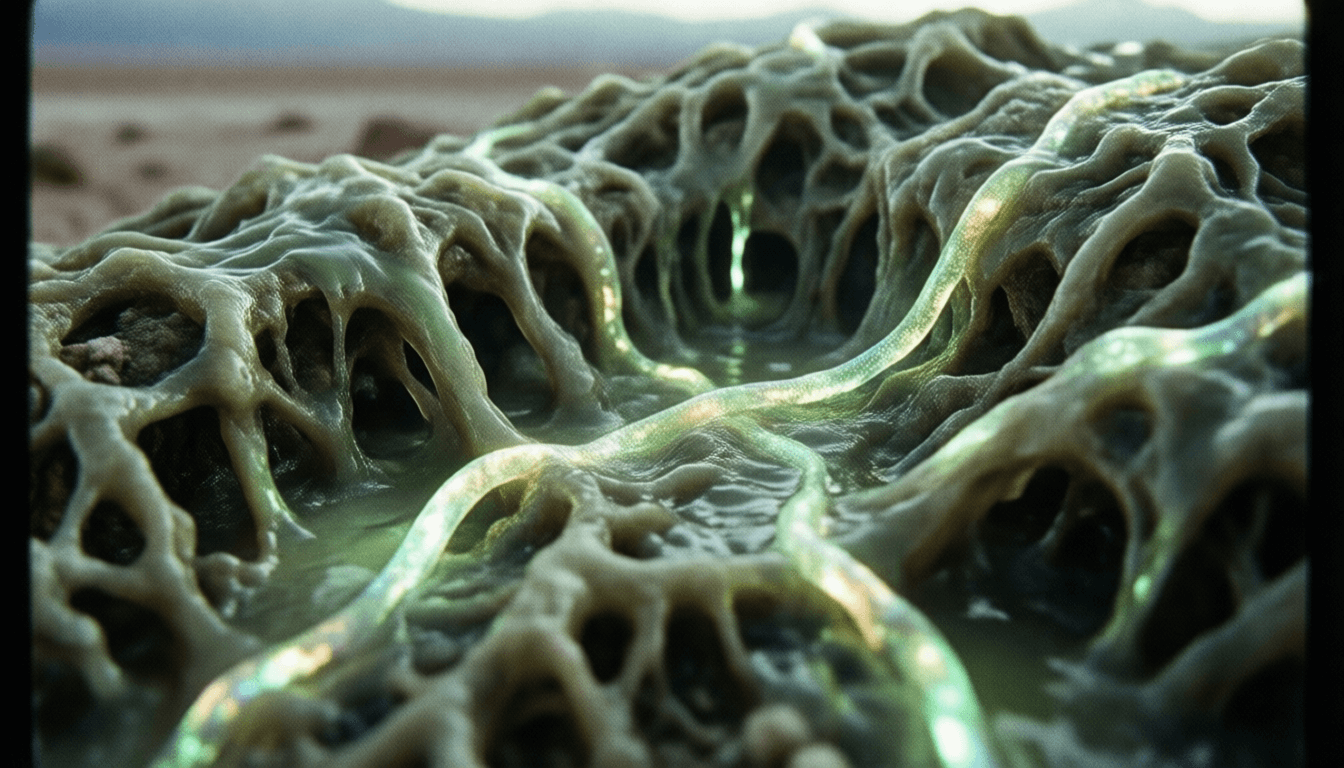
I followed the flow of water deeper into an internal cavity of the structure, where several channels converged into a central basin. The collected water here glowed with a faint internal light, slowly churning without any visible force. Driven by a desire to directly sample the primary outflow, I extended my arm and collecting vial towards the shimmering pool.
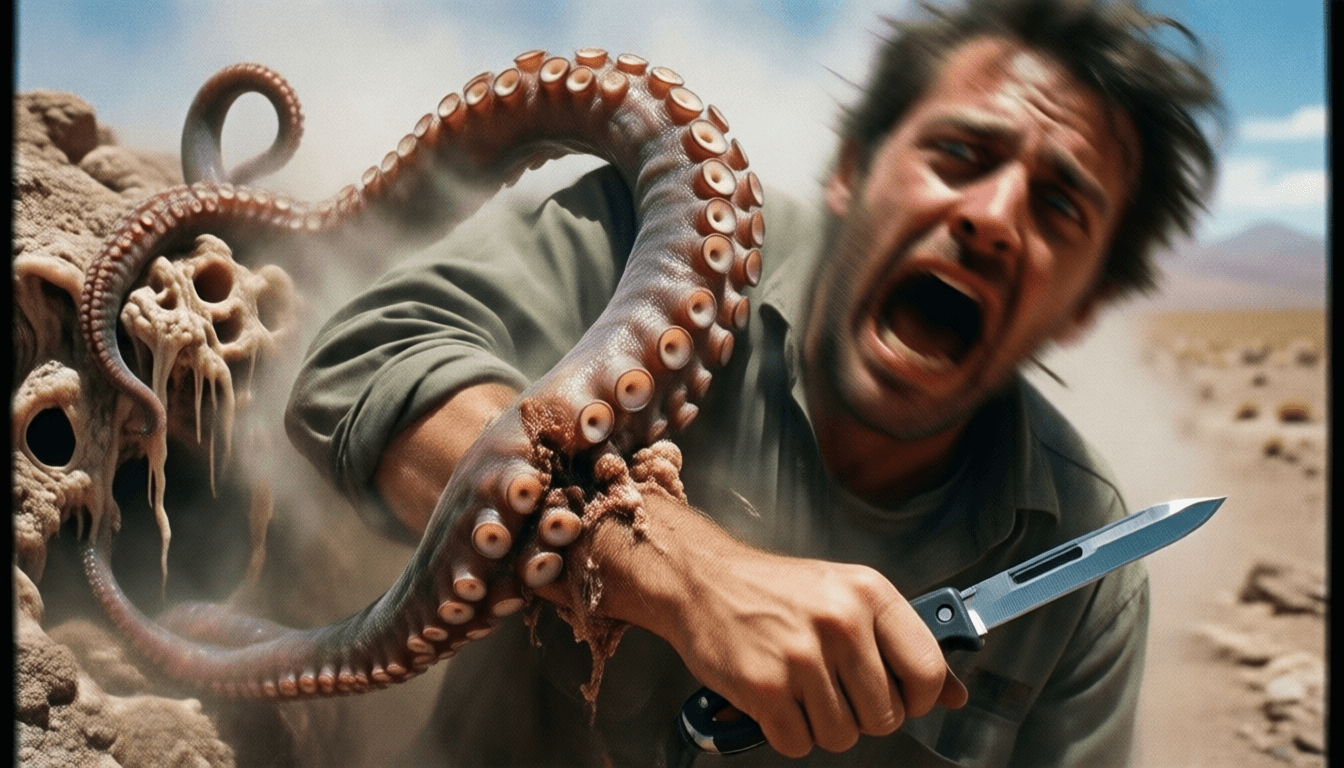
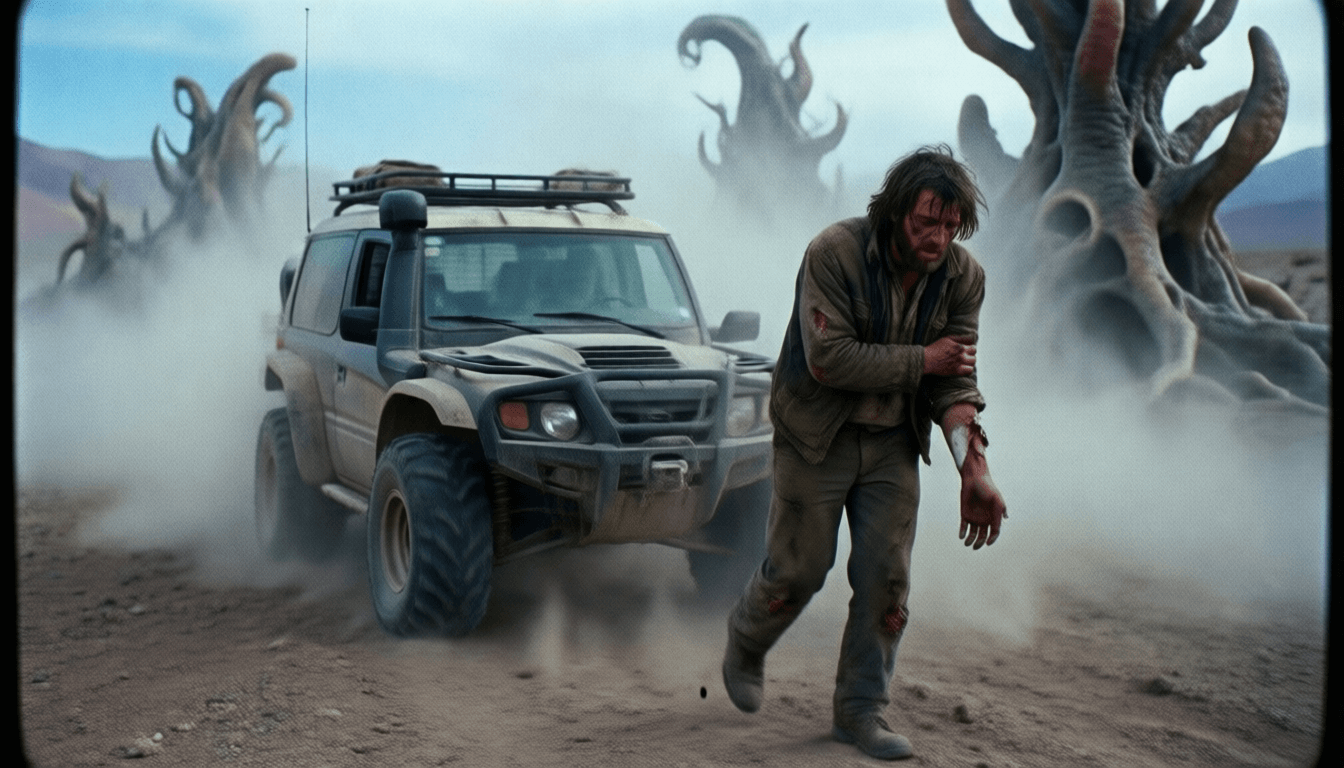
It happened with a terrifying, impossible speed. A section of the intricate lattice-work, previously indistinguishable from the surrounding structure, writhed. It wasn't a mechanical hinge or a collapsing support. It was muscle. A colossal, chitinous tentacle, previously disguised as part of a 'branch', erupted from the basin's edge. It moved with the power and fluidity of something vast and alive. Its surface was like compressed fungal mycelia, yet possessed the strength of reinforced steel. Before I could react, it lashed out, striking my arm, sending the collection vial flying. The impact was brutal, shattering bone. My scream was suddenly swallowed by a horrifying inhale that seemed to echo from all the structures around me, as if the air was being forcibly sucked from my lungs. The tentacle coiled around my forearm with a sickening, impossible pressure, further crushing the bone.
The surrounding fog instantly intensified into a physical barrier, swirling into a disorienting, claustrophobic vortex that obscured vision beyond a meter. The thrumming devolved into a violent, guttural roar felt deep in the bones. I wasn't being attacked. I was being assimilated. The tentacle wasn't crushing me to break me; it was attempting to absorb me. I felt a strange, draining cold spread from the point of contact, a deep, systemic chill. Desperation fueled me. With my uninjured hand, I fumbled for the utility knife on my belt. The tentacle, for all its immense strength, felt slightly porous. I plunged the blade into its surface, not expecting damage, but a reaction. A thick, viscous ichor, faintly smelling of ozone and damp earth, oozed from the wound. The tentacle recoiled slightly with an organic spasm, and I used that momentary slackness to twist my arm free with a shriek, leaving torn flesh and bone behind. I half-crawled, half-stumbled backwards, the colossal structures around me seeming to groan and shift, the tentacle slowly, deliberately receding back into its disguised state, vanishing into the monumental 'Weave'.
I made it back to my vehicle in a daze of pain and a deep, bone-chilling cold. My arm was horribly mangled, but I was alive. The escape was a brutal scramble through the unnaturally thickened fog, the air filled with the unsettling, receding groans of the colossal structures. When the helicopter finally located my emergency beacon, paramedics attributed severe hypothermia in the desert to shock and blood loss, dismissing my frantic, fragmented statements about "living structures" as delirium. My injuries, they concluded, were from a fall, likely impacting sharp rock.
I still bear the scars. Both physical and unseen. My arm healed, but nerve damage remains, a constant phantom cold radiating from the point of contact. The few samples I managed to retrieve – traces of viscous ichor on my knife, microscopic fragments of the structure embedded in my clothes – have been dismissed by every lab I've contacted. "Contaminated," "anomalous but explainable biological detritus," "a very unusual fungal species," were the only answers. No one wants to admit the impossible.
But Sky-Watch Alpha's images still exist. Though harder to find, the faint, low-frequency thrum still echoes in my dreams. I know what I saw. I know what touched me. The 'Green City' isn't a metropolis built by human ingenuity, but something else entirely. A vast, biomechanical entity woven into the very fabric of the desert itself, silently harvesting, expanding, alive. And sometimes, when the Atacama winds carry the scent of distant moisture, I can almost feel the faint, undeniable pull of what tried to consume me, that cold echo, a chilling whisper that the desert isn't dead, but merely breathing very, very slowly.
[ CLASSIFIED VERDICT ]
[ACCESS LOG - SOURCE FILE]
Whispers circulated about a 'Green City' deep within the Atacama Desert. Rumored to sustain itself with cloud-harvesting technology in the world's driest desert, mainstream science dismissed it as a mirage. However, satellite images revealed anomalous chlorophyll density and colossal, fractal-shaped organic structures, giving rise to new speculation about a biomechanical cloud harvester dubbed the 'Atacama Weave'.