
Silent Predator: The Kongamato of Jiundu Swamp
The first widely reported account, penned by Frank H. Melland in his 1923 book, In Witchbound Africa, described a "flying lizard" with leathery wings, a long beak, and teeth. The description of this creature, known to locals as "Kafulu"—"the boat-breaker"—was collected from indigenous people of Zambia's Jiundu Swamps and later reinforced by claims from explorers like Ivan T. Sanderson in 1932, who reported witnessing a massive, unidentified aerial disturbance near Lake Bangweulu. For decades, the Kongamato remained a footnote in cryptozoology—a fascinating but unverifiable relic.
However, recent regional anomalies demand a re-evaluation. Over the past five years, official reports from the Zambian Waterways Authority have documented an increase in submerged vessel damage and unexplained disappearances in certain remote channels of the Jiundu Swamps. These incidents deviated significantly from typical crocodile or hippopotamus attack patterns. Thomas Nkosi’s fishing boat wreckage, recovered in early 2023, was particularly unusual. The hull bore a single, massive laceration—not a bite mark or crush damage—but a gouge over two meters long, as if something incredibly sharp and heavy had scraped across the fiberglass. Nkosi himself remains missing. Local fishermen, already wary of Jiundu's deeper channels, now refer to "shadows that make the air heavy" and consider the area absolutely forbidden, reporting sharp, hoarse vocalisations heard only at dawn and dusk, unlike any known bird or mammalian call. This persistent, consistent local dread, now coupled with unexplained physical evidence, demanded immediate, clandestine investigation.
My entry point was a narrow, overgrown channel leading into the lesser-known parts of Jiundu. The air hung thick with suffocating humidity, dense with the smell of decaying vegetation and wet earth, punctuated by the high-pitched hum of unseen insects. I used a small, flat-bottomed skiff, silent save for the dipping of my oars. Kwena, my local guide, initially stoic, grew increasingly agitated as we neared the channel's entrance. He pointed to a particular, almost entirely obscured passage, his face contorted. "Beyond this, the air changes. It is the realm of 'Kafulu.'" He refused to proceed further, insisting he would wait at the channel mouth, his eyes wide with ancient terror. The journey beyond was solitary.
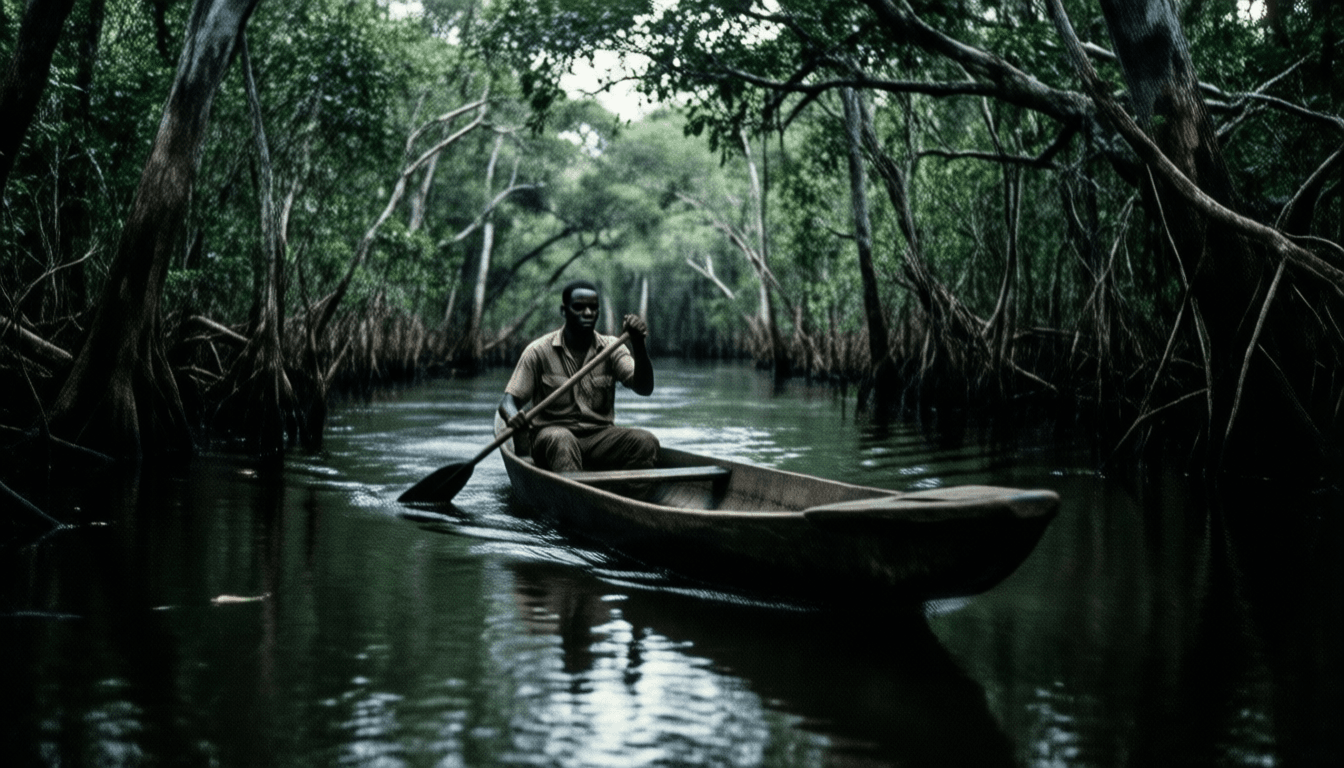
Above, the canopy grew denser, creating a perpetual twilight, and the water below was a dark, impenetrable mirror, reflecting an oppressive green. I moved slowly, senses hyper-alert, the oppressive silence of the inner swamp already beginning to weigh on me.
The initial anomalies were subtle, almost imperceptible. The swamp's deafening symphony—the cicadas, the distant monkey calls, the rustling of unseen creatures—began to wane. Not gradually, but as if an invisible curtain had descended, *absorbing* the sound. Deeper in, the silence was profound, unnatural, almost painful. It wasn’t merely quiet; it was an active absence of sound, as if the air itself refused to carry vibrations.
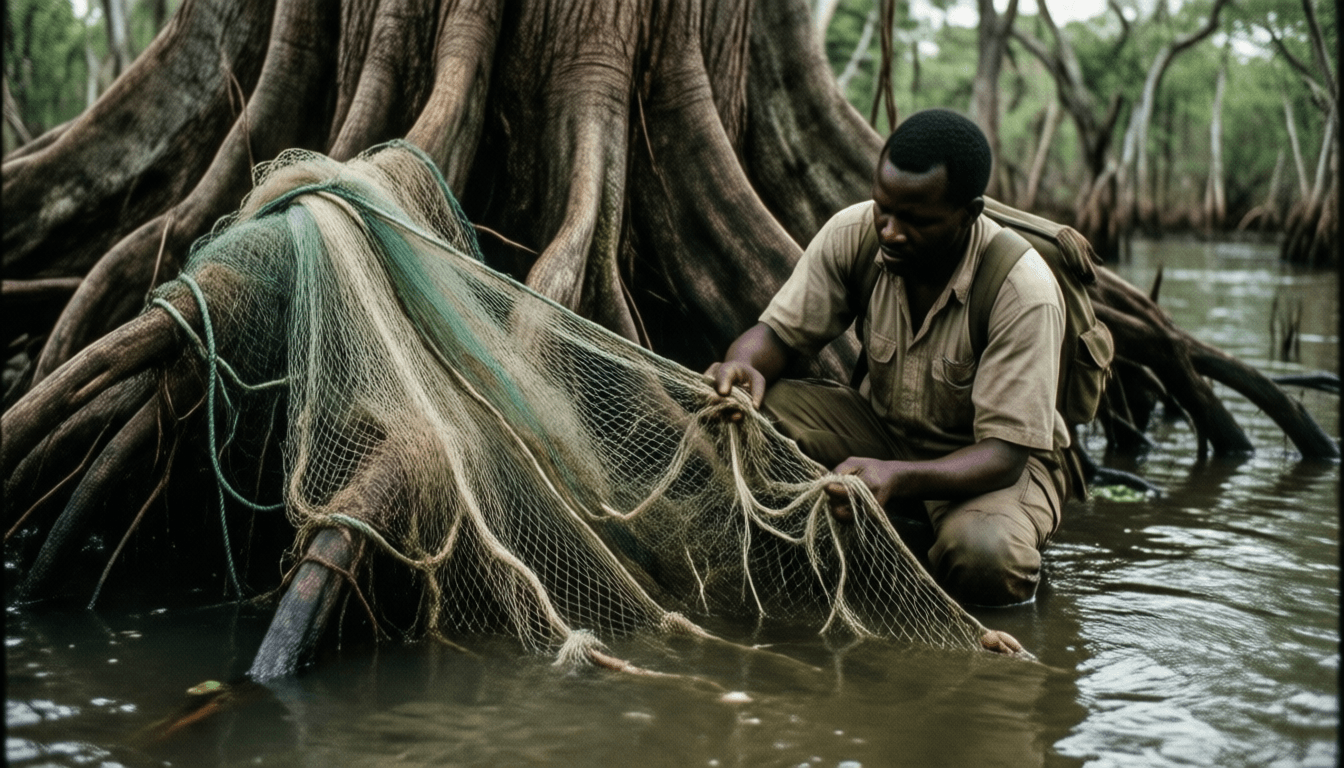
The water itself began to behave strangely. The current, usually slow in the narrow channels, would momentarily falter, then inexplicably reverse for brief, inexplicable moments, creating fleeting, contradictory ripples flowing upstream before vanishing. Sunlight, filtered through the thick canopy, cast fractured beams onto the water. Periodically, these beams would abruptly, jarringly extinguish. It was as if something colossal had passed far above the canopy, directly over the sun, yet created no shadow on the ground or water below. The sensation was disorienting, seeming to encompass the entire sky in a blink. An unidentified odor began to permeate the air—not the familiar swamp gas, but a metallic, damp scent, sour and ancient, as if something fossilized had returned to moist life. Then, a sudden, inexplicable drop in temperature, a short, chilling sigh of cold in the humid heat. Clinging to the twisted roots of a submerged tree, I found a piece of Nkosi’s fishing net. Not merely torn, but shredded with unnatural force, the synthetic fibers almost melted at their edges, as if exposed to immense friction or localized heat.
I entered a wide, circular lagoon, surrounded by massive, gnarled trees, the eerie stillness palpable. The anomalies rapidly intensified. The pervasive silence was now absolute, suffocating. The air grew heavier, viscous, each breath an conscious effort, as if the atmospheric pressure around me was intensifying. The lagoon’s surface began to churn, not from wind, but from invisible forces pressing down, creating circular depressions radiating outwards from the center.
And then, a sound that wasn't a sound: an incredibly deep, resonant *WOOMPH* of air displacement above me. It was so powerful it vibrated through the boat and into my bones, yet there was no wind noise, no flapping, nothing one would expect from a creature with massive wings. It was pure atmospheric shockwave. I looked up. A colossal, indistinct shadow streaked across the highest points of the canopy. It didn't fly, but moved in a strange, almost fluid distortion of space, seeming to *bend* light around its form, appearing and disappearing from view amongst the leaves in an instant—a visual illusion defying the laws of optics.
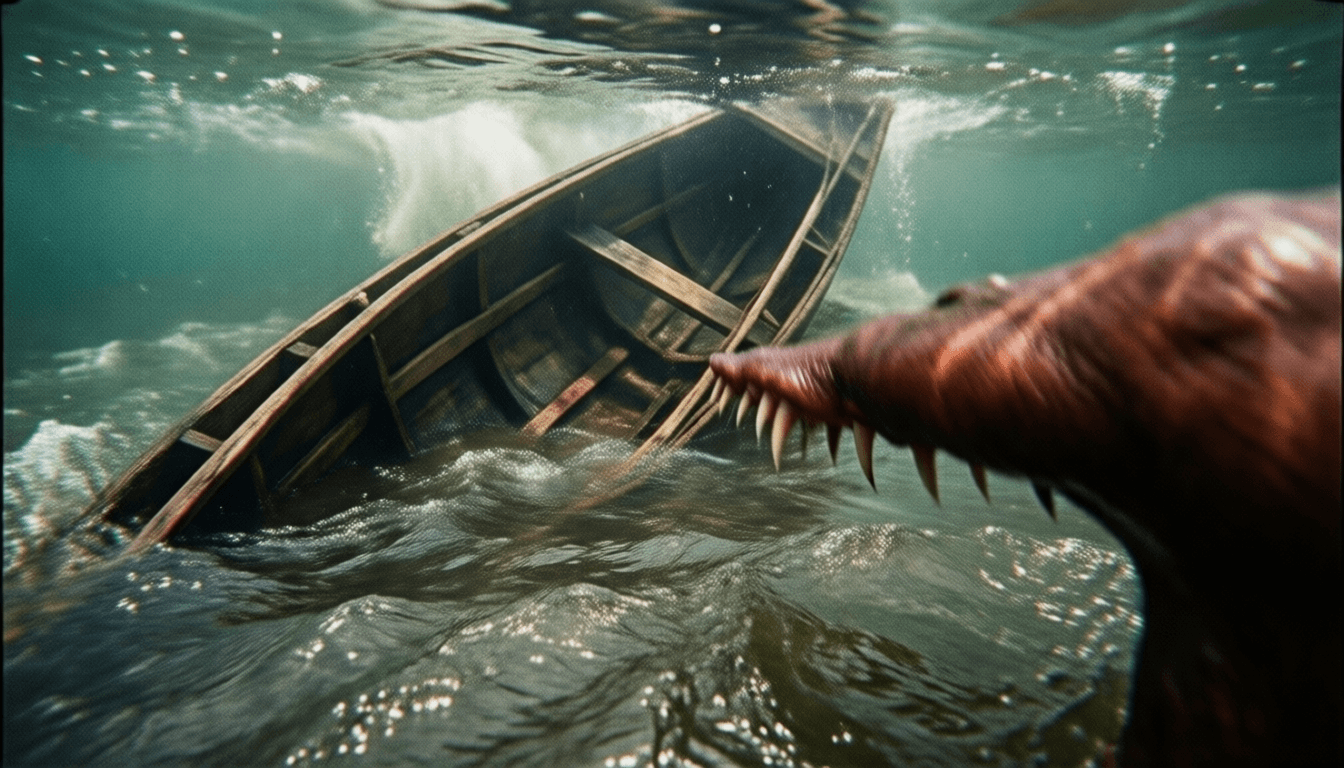
My boat was suddenly, violently struck from above. Not a direct physical impact, but as if a wall of compressed air had hit it. The skiff instantly capsized, and I tumbled into the murky water. As I struggled, disoriented and entangled in submerged weeds, a flash of mottled, leathery red skin streaked inches from my face in the dim gloom. An incredible array of needle-sharp teeth set in a long, narrow snout. It wasn’t biting or grasping. It was a deliberate, terrifying proximity, a massive, silent force brushing past my leg. The water around me began to boil, not with bubbles, but with intensely localized pressure differentials, alternately sucking and pushing, threatening to tear me apart.
Gasping, I surfaced, desperately clinging to my overturned boat. The *WOOMPH* returned. This time, stronger, echoing above me, almost sucking the air from my lungs. I looked up again. For a single moment, it was directly above me. A nightmare of ancient muscle and sinew. The colossal, bat-like wings, despite their span, were impossibly silent. Its eyes were dark and unreflecting, fixed with an ancient, predatory intelligence. The air around its body shimmered, distorting light, making its outline waver and ripple, as if moving through an atmosphere of different density, or perhaps generating a localized field that bent the very fabric of perception. It did not directly attack. Instead, it repeatedly swept past in an incredibly fast, utterly silent manner, each pass generating a focused pressure wave that slammed into my body, pushing me underwater, stealing my breath. It was a sustained, terrifying demonstration. A silent, deadly game of terror. Its message was clear and absolute: You are an intruder. This domain is not yours.
I eventually stumbled, half-drowned and disoriented, most of my equipment lost, back into the main channel. Kwena’s face paled at my condition, but he asked no questions. He simply turned the boat around and hastened us back to the nearest outpost.
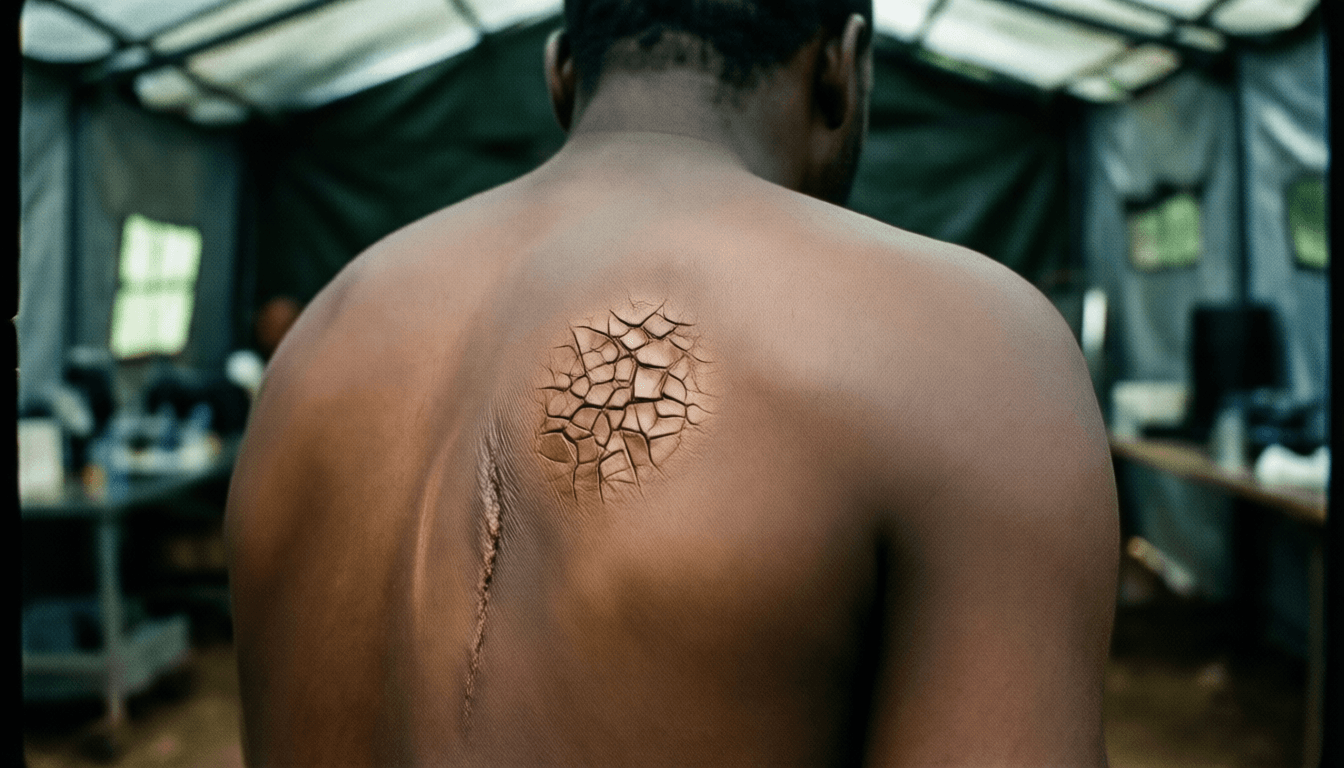
Days later, even in the sterile environment of my field analysis base, the sensation of that oppressive air displacement lingered, and the ghostly metallic-damp odor returned in sudden, sickening waves. I was obsessively examining my skin. On my lower back, just below my left shoulder blade, was a faint linear abrasion. It wasn't deep, certainly not a claw or tooth mark, but a subtle imprint where something heavy and ridged had momentarily pressed. Under magnification, it revealed an incredibly fine, almost imperceptible pattern of indentations—like ancient, wrinkled leather or a mosaic-like organic texture. It matched no known terrestrial creature.
I pored over weeks of archived zoological data, obscure cryptozoology records, and transcribed Zambian folklore. I found crude charcoal sketches of “Kafulu” provided by witch doctors to early European explorers in the 1930s. The proportions, the implied texture of the wings, the vague hints of its form… they matched the pattern on my skin.
Finally, the chilling realization was not about the specific cryptid, but about how it operated. Its ability to bend light, displace air, and move with shocking force, yet incredibly silently for its size, was not supernatural. It was a creature so perfectly evolved, its biomechanics so alien, that it could interact with the very fabric of reality in ways we are only beginning to comprehend. It was not a monster from children’s tales, but a living, ancient predator operating on different laws of physics, using those laws with deadly precision to deliver a very clear, very silent message: Do not enter. The world, I now understand, is far stranger, infinitely deadlier, than our narrow scientific understanding allows. The abrasion on my back now feels less like a scar and more like a brand. A permanent record of an impossible, terrifying truth.
[ CLASSIFIED VERDICT ]
[ACCESS LOG - SOURCE FILE]
The Kongamato is a cryptid legend of a "flying lizard" first reported by Frank H. Melland in 1923 from Zambia's Jiundu swamps. Known to locals as "Kafulu," meaning "boat breaker," this creature is described with leathery wings, a long beak, and teeth, and has remained a mysterious entity for decades in cryptozoology.